
Diaphragm seal pressure gauge
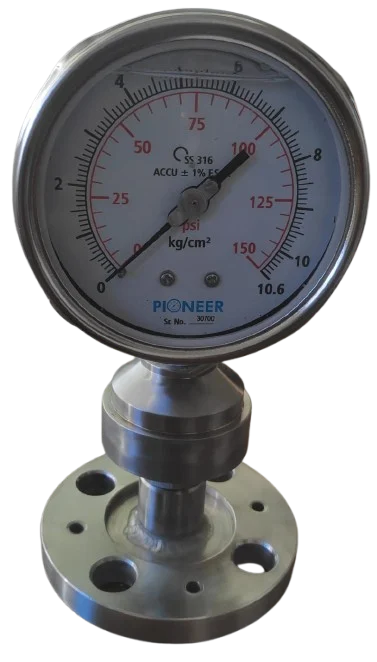
A diaphragm seal pressure gauge keeps the process away from the gauge: a flexible diaphragm transmits pressure through a fill fluid, so slurries, viscous, crystallising or corrosive media cannot block or attack the Bourdon tube. Pioneer supplies diaphragm gauges with a 100 mm SS 304 case and blow-out device, dry or liquid filled, with materials confirmed at quotation.
- Dial
- 100 mm
- Case
- SS 304
- Fill
- Dry, glycerine or silicone
Quotation within one working day of your BOQ. Supply across India and export, FOB Nhava Sheva.
How it works and when to use it
Bourdon tubes are thin and narrow. Feed them sludge, a crystallising chemical or a polymer and they block; feed them an acid and they corrode. A diaphragm in front of the gauge solves both: only the diaphragm touches the process, and it can be made in a material chosen for that medium.
Diaphragm gauges also read low pressures better than Bourdon gauges, because the diaphragm has a large area. Send the medium, its temperature and the pressure range, and we confirm the diaphragm material, connection and fill.
Versions
- Diaphragm gauge. Diaphragm built into the gauge, for low pressures and moderately difficult media.
- Gauge with diaphragm seal. Separate seal threaded or flanged to the process, for corrosive, hot or viscous media.
- Remote seal on capillary. Seal on a capillary for hot media or hard-to-reach points.
Typical applications
- Effluent and sewage treatment
- Slurries, paper stock and food pastes
- Acids, alkalis and chlorine dosing
- Polymers, resins and crystallising chemicals
- Hygienic and pharma lines
Specification
| Parameter | Value |
|---|---|
| Dial size | 100 mm |
| Window | Laminated safety glass or polycarbonate |
| Connection location | Bottom (radial); side or back on request |
| Case | Stainless steel 304, with blow-out device |
| Movement | Stainless steel |
| Case filling | Dry, glycerine-water mixture or silicone oil (filled cases have a vent and reseal valve) |
| Diaphragm material, connection, range | Confirmed at quotation for your medium |
Other ranges, units, connections and dial sizes on request. Send your medium, range and connection and we match the model.
Consultant specification clause
Paste into your technical specification or BOQ and adjust ranges and quantities.
- Pressure gauges on corrosive, viscous, slurry or crystallising media shall be fitted with diaphragm seals; diaphragm material to suit the medium.
- Gauge 100 mm, SS 304 case with blow-out device, liquid filled where pulsation is expected.
- Make: Pioneer Industrial Instruments, Pune, or approved equivalent.
Questions buyers ask
When do I need a diaphragm seal?
When the medium could block, freeze, crystallise in or corrode a Bourdon tube, or when the process is too hot for the gauge.
Does a diaphragm seal reduce accuracy?
It adds a small error, mainly from temperature changes of the fill fluid. Keep capillaries short and both seals at the same temperature on DP duty.
What details do you need to quote?
Medium, operating and maximum temperature, pressure range, process connection (thread or flange) and quantity.
Can the diaphragm seal be flanged?
Yes. Seals can be threaded or flanged; the photo shows a Pioneer gauge on a flanged diaphragm seal. The flange standard and size are confirmed at quotation.
Which media need a diaphragm seal gauge?
Slurries, sludge, viscous liquids, crystallising chemicals, acids and alkalis, polymers, hygienic and very hot media.
Related
- Stainless Steel Pressure Gauge
- Differential Pressure Gauge
- Glycerine Filled and Weatherproof Pressure Gauge
- Siphons, valves and accessories
Need the data sheet? Call or WhatsApp +91 93700 39974 or email info@pioneerinstrumentation.com.