
Pressure gauges
Pioneer makes Bourdon tube pressure gauges in Pirangut, Pune: all-stainless with SS 316 tube and socket, dials from 40 to 250 mm, ranges from 0–1 to 0–600 kg/cm² plus vacuum and compound, ±1% FSD as per IS 3624. Below are the types we supply and where each one fits.
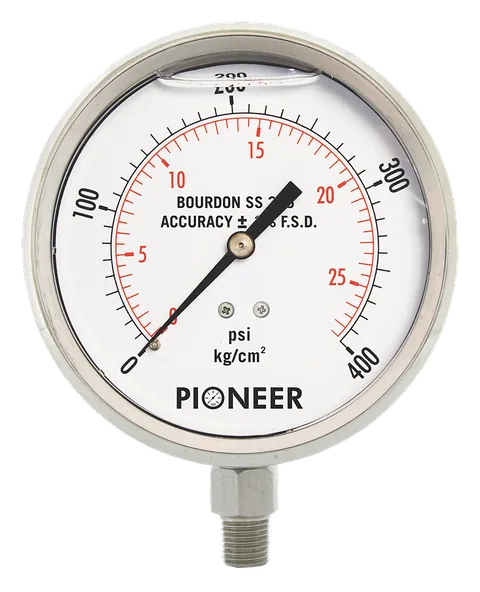
Stainless Steel Pressure Gauge
Most specifiedSS 316 tube, SS 304 case, 40–250 mm, 0–1 to 0–600 kg/cm², ±1% FSD to IS 3624
View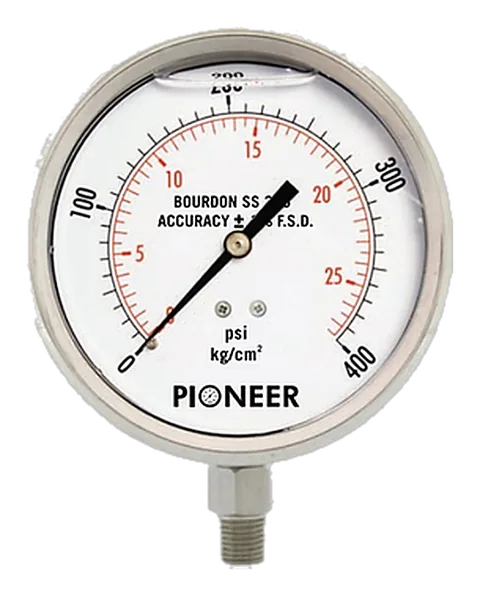
Glycerine Filled and Weatherproof Pressure Gauge
Pumps, compressors, outdoorsGlycerine or silicone filled, IP 65 / IP 67, blow-off disc
View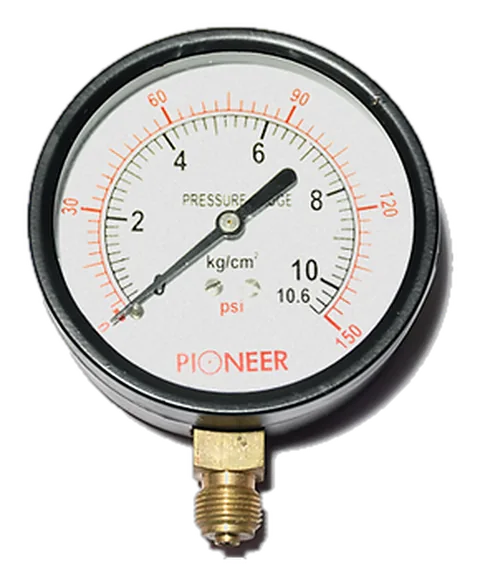
Commercial Pressure Gauge
OEM and indoorMS powder-coated case, brass system, 40–100 mm, IP 54
View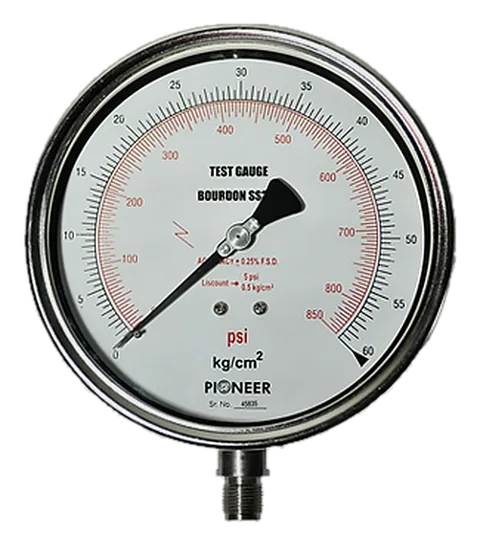
Test Gauge (±0.25% FSD)
Hydro test and calibration±0.25% FSD, 100–250 mm, knife-edge pointer
View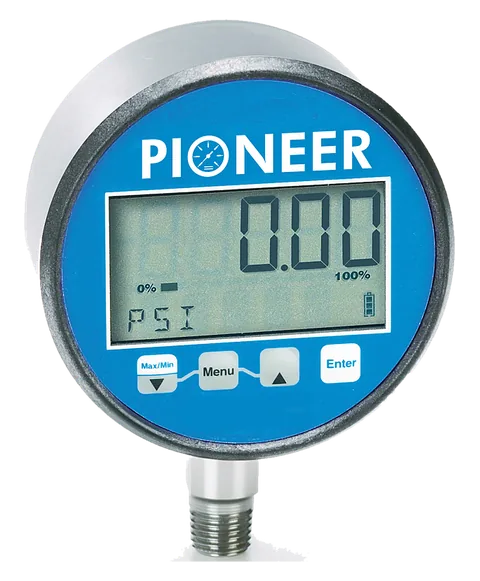
Digital Pressure Gauge
CommissioningBacklit LCD, 0.5% FS, −100 kPa to 100 MPa
View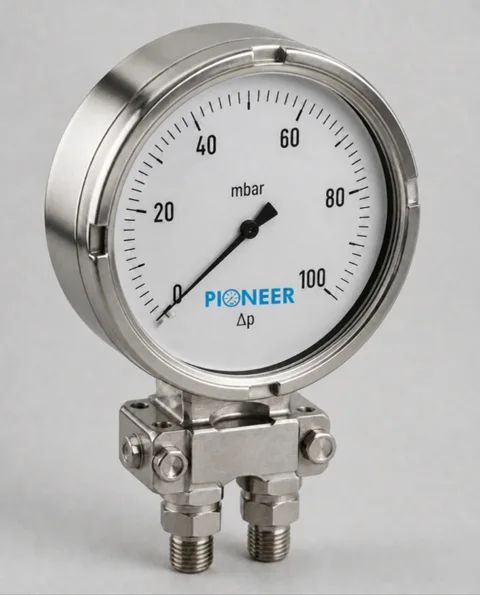
Differential Pressure Gauge
Filters and strainersΔp on one dial; 0–100 mbar remote-seal version
View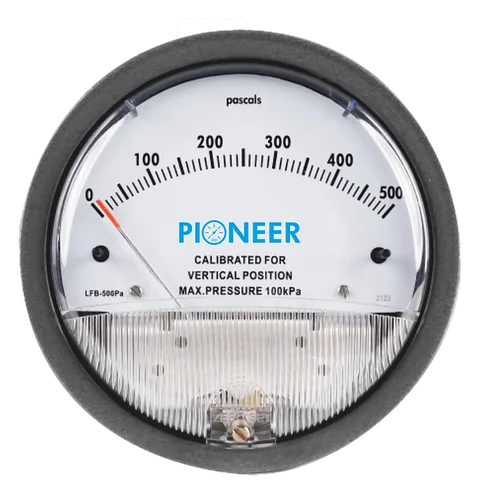
Magnehelic Gauge
Clean rooms and AHUs0–60 Pa to 0–8 kPa, 100 mm dial, ±3% FS
View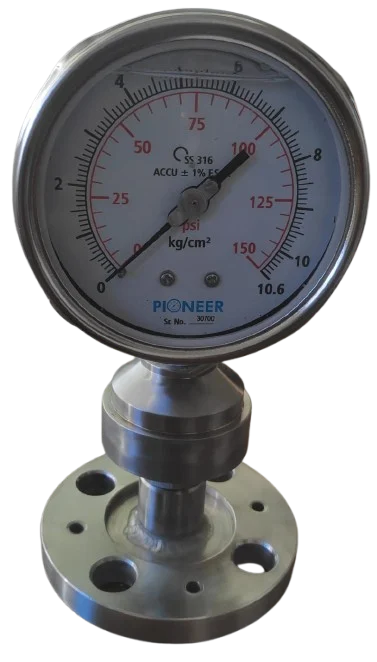
Diaphragm Seal Pressure Gauge
Corrosive and viscous media100 mm SS 304 case, diaphragm isolates the process
ViewChoosing quickly
- Clean liquid or gas above about 1 kg/cm²: stainless steel gauge.
- Pump, compressor or vibration: glycerine filled, with a snubber.
- Steam: any SS gauge plus a siphon.
- Slurry, acid, polymer or very hot media: diaphragm seal.
- Across a filter or strainer: differential pressure gauge; for air in pascals, the Magnehelic gauge.
- Checking other gauges or witnessing a hydro test: test gauge.
Range rule of thumb
Choose a full scale about twice the normal working pressure, so the pointer sits near mid-dial and the maximum stays below 75% of full scale (two thirds on pulsating service). The range selector does it for you.
| Working pressure | Range to order |
|---|---|
| 3 kg/cm² | 0–6 kg/cm² |
| 5 kg/cm² | 0–10 kg/cm² |
| 8 kg/cm² | 0–16 kg/cm² |
| 12 kg/cm² | 0–25 kg/cm² |
| 20 kg/cm² | 0–40 kg/cm² |
Siphons, valves and accessories
Pioneer supplies the hook-up with the gauge, so everything arrives together and can be quoted as one line item.
| Accessory | What it does |
|---|---|
| Siphons (U-type and pigtail / Q-type) | Hold a column of condensate in front of the gauge so live steam never reaches the Bourdon tube. SS 3/8" and 1/2", MS, and Schedule 80 versions; also as a combination with an SS ball valve. |
| Snubbers | Small restrictions that damp pressure spikes from reciprocating pumps and quick-closing valves; use with a glycerine filled gauge. |
| Ball valves | Quarter-turn isolation so a gauge can be changed without shutting the line. SS 3/8", brass and gunmetal versions. |
| Needle valves | Fine isolation and throttling, SS 304 1/2". |
| Stop cocks | Simple isolation for utility gauges, 1/2". |
| Pressure / temperature test plugs | Let a technician take a spot reading with a portable gauge or probe without draining the line. |
| Thermowells | Barstock and fabricated SS, see thermowells. |
| Calibration certificates | Calibration with a certificate from an NABL-accredited laboratory, on request with the order. |
Data sheet
Questions buyers ask
What is the most common pressure gauge size?
100 mm (4 inch) for pipelines and plant rooms, 63 mm (2.5 inch) for panels and equipment, 150 mm (6 inch) where the gauge is read from a distance.
Which material should the pressure gauge be?
SS 316 wetted parts (Bourdon tube and socket) with an SS 304 case is the safe default and Pioneer's standard. Brass internals in an MS case are fine for clean, dry, indoor service.
What information do you need to quote a pressure gauge?
Medium, normal and maximum pressure (or the range), dial size, connection thread and position, filling, accessories and quantity. A BOQ line or a photo of the old gauge also works.