
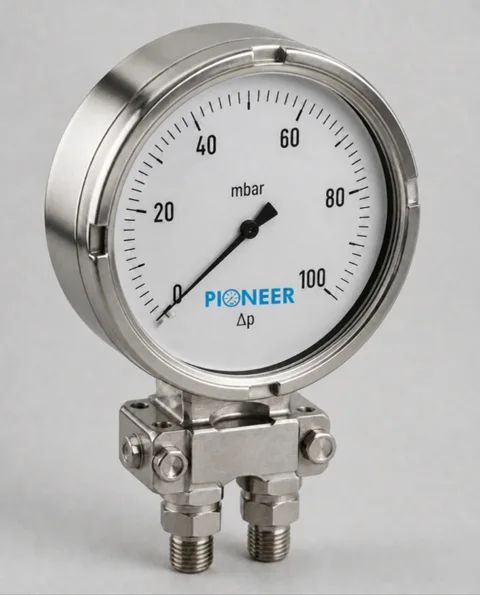
Differential pressure gauge
A differential pressure gauge reads the difference between two pressures, such as across a filter, strainer, coil or flow element, on one dial. Pioneer supplies analog (dial) DP gauges in stainless steel with dual bottom connections, a 0–100 mbar diaphragm-operated remote-seal DP gauge with a 150 mm SS 304 case, and digital DP indicators.
- Reads
- Δp, one dial
- Remote seal
- 0–100 mbar
- Case
- Stainless steel
Quotation within one working day of your BOQ. Supply across India and export, FOB Nhava Sheva.
How it works and when to use it
Two separate gauges and a subtraction is how most plants first measure a filter, and it rarely works: each gauge carries its own error, and a small differential gets lost in a large line pressure. A DP gauge measures the difference directly, so the change that tells you a filter is choking shows up clearly.
For air-side differentials in pascals, such as clean rooms, AHU filters and duct static, use the low differential pressure gauge.
Versions
- Analog differential pressure gauge. Dial gauge with dual bottom process connections on a stainless connection block; for filters, strainers, coils and heat exchangers.
- Remote-seal DP gauge. Diaphragm operated, 0–100 mbar, with flanged remote seals on 3 m capillaries; for dirty, hot or viscous media.
- Digital DP indicator. Numeric reading in Pa for HVAC and clean-room monitoring.
Typical applications
- Filters and strainers on water, oil and process lines
- Chiller and heat-exchanger pressure drop
- Orifice plates and flow elements
- Tank level by hydrostatic head
Specification
| Parameter | Value |
|---|---|
| Pressure type | Differential pressure (Δp) |
| Process connections | Dual, bottom entry, male thread; typically 1/4" or 1/2" NPT / BSP |
| Case and connection block | Stainless steel |
| Dial | White, black numerals and graduations |
| Pointer | Black, micro-adjustable, front zero adjustment |
| Window | Instrument glass or shatter-resistant polycarbonate |
| Parameter | Value |
|---|---|
| Range | 0–100 mbar |
| Type | Remote seal, diaphragm operated |
| Dial | 150 mm, linear scale, black on white |
| Diaphragm | SS 316 |
| Case / bezel | SS 304, bayonet bezel ring |
| Movement | SS 304, geared |
| Process connection | 1", ANSI Class 150 RF flanged remote seals |
| Capillary | 3 m, silicone-oil filled |
| Over-range protection | 150% of maximum pressure |
| Protection | IP 65 |
| Mounting | Surface, with bracket and U-clamp |
Other ranges, units, connections and dial sizes on request. Send your medium, range and connection and we match the model.
Consultant specification clause
Paste into your technical specification or BOQ and adjust ranges and quantities.
- Differential pressure gauges shall indicate Δp directly on a single dial with stainless steel case and connection block.
- Range so that the alarm (dirty filter) differential lies between 50% and 80% of full scale.
- Supplied with a 3-valve or equalising manifold where scheduled. Make: Pioneer Industrial Instruments, Pune, or approved equivalent.
Questions buyers ask
Why not use two pressure gauges and subtract?
Each gauge has its own error, which can be larger than the differential you want to see. A DP gauge measures the difference directly.
What is a remote-seal DP gauge for?
For media that would block or attack the gauge, or are too hot: diaphragm seals on capillaries keep the process away from the instrument.
Which DP gauge for an AHU filter?
Air filters need pascal ranges. Use the low differential pressure gauge, 0–250 or 0–500 Pa for most filters.
What is a differential pressure gauge used for?
To show the pressure difference across a filter, strainer, coil, heat exchanger or flow element on one dial, so a choking filter or a change in flow is seen directly.
What is the range of the remote-seal DP gauge?
0–100 mbar, with a 150 mm SS 304 dial, SS 316 diaphragm, 1" ANSI 150 RF flanged seals on 3 m capillaries and 150% over-range protection.
Related
Need the data sheet? Call or WhatsApp +91 93700 39974 or email info@pioneerinstrumentation.com.